What the research says
Three things the well rehabilitation research agrees on
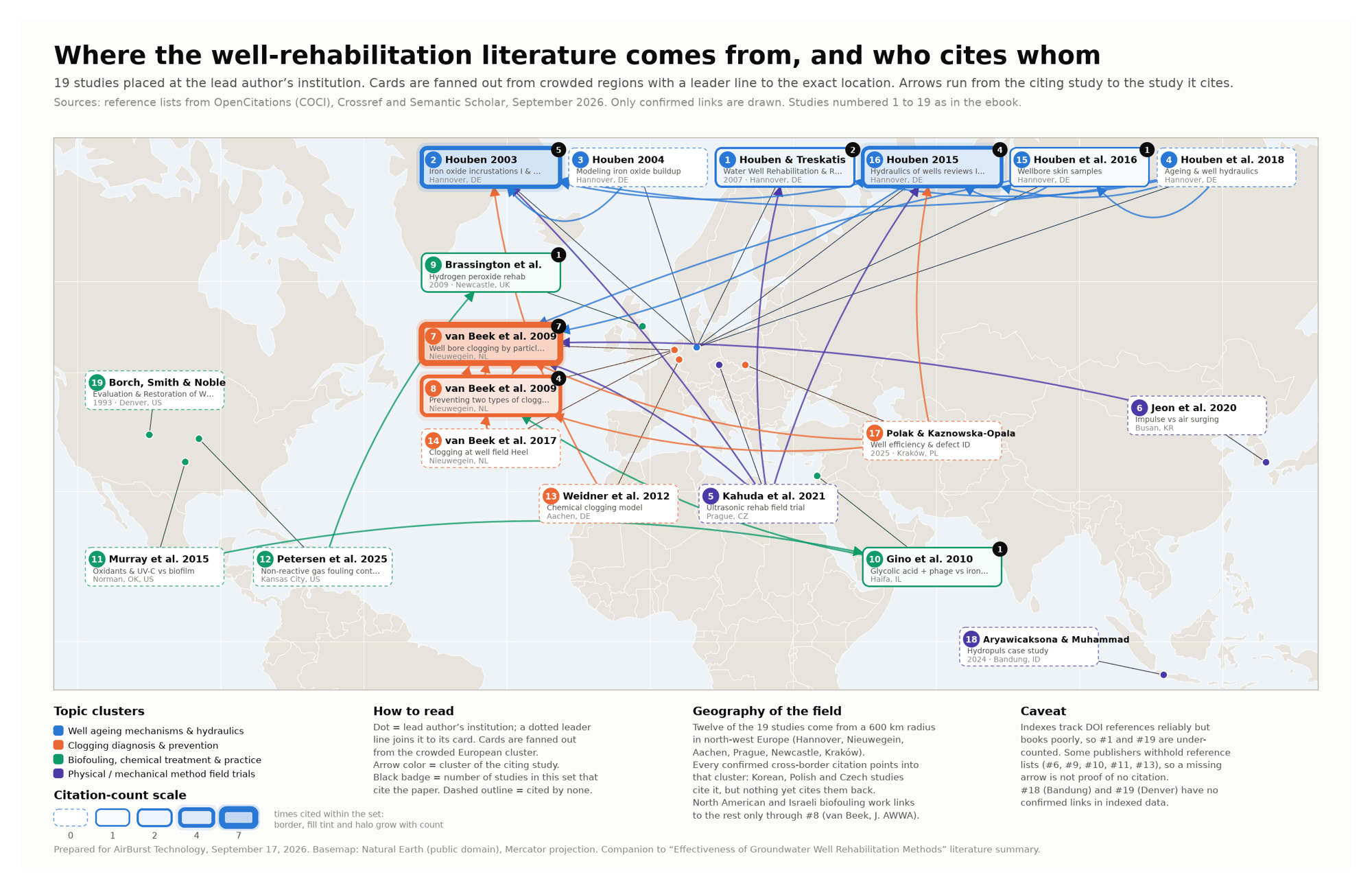
Nineteen studies from four research traditions do not automatically agree with each other. On three points they do, and each was reached by independent routes without the authors citing one another. That is what makes the agreement worth paying attention to.
1. The gravel pack, not the screen, controls well yield.
Hydraulic modeling from Germany's Federal Institute for Geosciences (BGR) shows that a well's yield drops sharply once the gravel pack has lost about 65 percent of its porosity, while the screen openings have to be roughly 98 percent blocked before they matter. Direct sampling of borehole skin material and a full-scale test rig reached the same conclusion by different methods. The practical consequence: a screen that looks terrible on a downhole camera may be a minor contributor to lost yield, and a rehabilitation method whose energy stops at the screen gives short-lived results.
2. Diagnose before you treat.
From a 1993 AWWA Research Foundation survey of US utilities to a 2025 analysis of 40 long-operated Polish wells, the most common cause of a failed well rehabilitation is treating a problem the well does not have. Mineral incrustation, iron bacteria and biofouling, particle clogging and corrosion each respond to different treatments, and the chemical that fixes one can make another worse. The German DVGW W 130 standard made a diagnostic sequence mandatory in 2007: specific capacity history, step-drawdown test, camera survey, deposit sample and dissolution test.
3. Oxygen is the root cause of iron clogging.
Iron oxide forms where anoxic, iron-bearing groundwater meets oxygen at the screen and gravel pack. It is also autocatalytic: the deposit that is already there speeds up the formation of more, which is why wells decline gently for years and then fall off a cliff, and why a half-finished rehab re-clogs faster than the original well did. Decades of Dutch well-field records and a 2025 oxygen-exclusion engineering study close the same loop from opposite directions.
"A well rarely gets back to its original specific capacity, and each successive rehab tends to recover a little less. Regular, monitored maintenance beats late crisis intervention. — Houben and Treskatis, Water Well Rehabilitation and Reconstruction (2007), the textbook the rest of the list keeps citing"
Where they disagree:
Intermittent versus continuous pumping, oxidants versus reductants, and how much yield a single rehab can really recover. The ebook has a chapter on each tension, and on which clogging type makes each side right.
Written by Michael Kerper, Michael Judkins, and Michael Yakich of AirBurst Well Services.